 |
| CALENDAR OF EVENTS
|
June 2007
|
| June 2007 at TENRI
|
|
|
|
1 (Fri.) - CONCERT:
Counter)induction (new music)
|
|
8:00 PM
SUGGESTED
DONATION $12
Counter)induction
SYNTHESIS
Counter)induction is a
composer/performer collective committed to the notion that contemporary
music can and should be both accessible and challenging. c)i celebrates
the diversity of contemporary music by presenting the best, most
innovative new music to both new and established audiences.
Their program explores the transformations of folk and vernacular
musical traditions.
PROGRAM
Sierra: Tema y Variaciones
Bartlett: Teratography
Bartok: Contrasts
Husa: Evocations de Slovaquie
Boyce: Piano Quartet
|
CLICK
HERE for more information on COUNTER)INDUCTION
|
|
3 (Sun.) - CONCERT: Sheila
Simpson, Leschetizky Association (piano)
|
|
3:00 PM
SUGGESTED
DONATION FOR NON-MEMBERS $10
2007
Annual Meeting
SHEILA SIMPSON, piano
Sheila Simpson, a native
Mississippian, has been a musician from a very early age. She played
her first solo recital at age eleven, and by fifteen had appeared as
soloist with three different orchestras.
Ms. Simpson attended the University of Alabama, studying with Roy
McAllister, and received a Masters Degree from the Manhattan School of
Music as a student of Dora Zaslavsky, graduating with honors from both
institutions. Other teachers have included Beveridge Webster, Adele
Marcus, Edna Golandsky, Arminda Canteros and Juana Zayas.
Numerous awards and scholarships enabled her participation in music
festivals such as the Brevard Music Center (NC), the Aspen Music
Festival, and the Yale Summer School of Music and Art. Additional
prizes include the Lura B. Friermood Award; Nan Burt Grant for Piano
Study; and Mississippi Music Clubs Scholarships. Competition prizes
include the MTNA Southeast College Competition; the Birmingham
Symphony, Shreveport Symphony, and Jackson Symphony; and a top prize in
the Pinault International Piano Competition with entries from 32
different countries.
Ms. Simpson has performed in New York City's Merkin Hall, Steinway
Hall, Lincoln Center, Weill Hall, and at the United Nations. She has
appeared as guest soloist with numerous orchestras, and performed
chamber music and solo recitals throughout the U.S., as well as
performances in London, Munich, Rio de Janiero, Toronto, Japan, and the
U.S. Virgin Islands.
She has been a featured concert artist, lecturer and adjudicator in
various music festivals and universities, most recently at a week-long
Teacher's Conference at Mississippi State University (2004). As a
teacher she has produced prize-winning students in piano performance
and composition.
|
CLICK
HERE for more information on the LESCHETIZKY ASSOCIATION
|
|
4 (Mon.)-
July 23 - JAPANESE LANGUAGE SCHOOL
|
|
SUMMER SESSION I
Tenri School of Japanese
Language accommodates students from beginning to advanced levels.
Utilizing a unique method which was developed many years ago at the
prestigious Tenri University, our courses are structured with a special
focus on the individual needs of the students in a program that will
allow each of them to meet his/her study goal.
Native
speaker/instructors help advanced and beginner students master the
Japanese language in small, multi-media classes. Our unique teaching
method, developed over the last 40 years at the prestigious Tenri
University employs traditional instruction with audio-visual aids to
immerse students in the Japanese language. In order to address the
individual needs of our students, even our most popular classes have a
class size limit of 13. Most of our classes average 3 to 5 students.
The school
facility includes a student library and lounge. Students may borrow
various books and audio / visual materials to supplement classwork and
texts.
Tenri Cultural Institute
also presents a variety of programs including the Traditional Japanese
Music Series, the Chamber Music Series, Divine Healing Sessions, art
exhibitions and other special events. All students receive discounted
admission privileges to Institute programs. For those who have
experience in Japanese, class placement is based on an evaluation
interview and/or test which can be arranged at your convenience.
We encourage you to visit
the school and observe a class for FREE. Call ahead to make an
appointment (212) 645-2800.
|
CLICK
HERE for more information on the JAPANESE LANGUAGE SCHOOL
|
|
| 9 (Sat.) -
CONCERT: Azure Ensemble (new music)
|
|
7:00 PM
Azure Ensemble
The Azure Ensemble is one of New
York City's most exciting new chamber music groups. Varied and
notable repertoire is a hallmark of the ensemble, which draws its
members from the finest musicians in New York City; a diverse
instrumentation allows the performance of both traditional and new
repertoire that may not always fit neatly into standardized
categories. Original programming is a hallmark of The Azure
Ensemble; the group has commissioned and premiered numerous works by
important contemporary composers, including Yuriko Kojima, Pablo Ortiz,
Anne LeBaron, Alan Shockley, Alice Shields, Yoon Hee Hwang, Amanda
Harberg, Jeeyoung Kim, Marilyn Bliss, and Stella Sung.
Members of The Azure Ensemble have achieved notable reviews and
credentials, including performances in Merkin Hall, Weill Recital Hall
at Carnegie Hall, Wigmore Hall in London, Alice Tully Hall, the John
Field Room of Irelands National Concert Hall, the Museum of Modern Art
in New York City, and the Dame Myra Hess Memorial Concert Series in
Chicago. Radio and television appearances include WNYC, WQXR,
KNAU, and Britains BBC. Members of The Azure Ensemble have performed at
the Aspen Music Festival and the Norfolk Contemporary Music
Festival. They have produced critically acclaimed CDs on the Koch
International Classics labels.
|
CLICK
HERE for more information on the AZURE ENSEMBLE
|
|
16 (Sat) - CONCERT: Glass
Farm Ensemble (new music)
|
|
8:00 PM
SUGGESTED
DONATION $15
Glass Farm
little accents
The Glass Farm concerts were
inaugurated in 2000 when pianist Yvonne Troxler began presenting
programs of new works by cutting edge American composers and music from
Europe’s thriving new music scene in the industrial Glass Farm Building
on Manhattan’s far west side. From the beginning these concerts
provided a place for a broad range of musicians and audience members to
interact up close. Likewise the programming created a space where
all manner of new music could rub up against important early twentieth
century chamber music, improvisation, wild experimentalism, non-Western
music, and even Schumann lieder. The frequent players from these
early concerts eventually coalesced into the Glass Farm Ensemble.
By the fall of 2003 the Glass Farm Ensemble had outgrown its original
space and moved to the Tenri Cultural Institute where it now holds its
annual four-concert New York season. With its flexible roster of
core musicians the ensemble is capable of configurations ranging from
solo instruments to the expanded group that appeared in the 2003 Swiss
Peaks Festival. The Glass Farm Ensemble continues its focus on
presenting imaginative programs in often non-conventional spaces that
invite the broadest possible audience to intimately experience
music. Composers with whom the ensemble has worked closely or
whose works have often been featured include György Ligeti, Louis
Andriessen, Frederic Rzewski, Wolfgang Heiniger, Balz Trümpy,
Dieter Ammann, Roland Moser, Elizabeth Hoffman, Elliot Sharp, and Peter
Herbert. In addition, the Glass Farm Ensemble has been building
an ever-expanding body of commissioned works and arrangements for one
of its primary line-ups of saxophone, guitar, percussion, and piano.
PERFORMERS
Miranda Cuckson Violin
Christoph Bösch Flute
Yvonne Troxler Piano
WORKS BY:
Christoph Bösch
Aldo Clementi
Franco Donatoni
Bruno Mantovani
Roberto Sierra
Christian Wolff
|
CLICK
HERE for more information on the GLASS FARM ENSEMBLE
|
|
19 (Tue.)
- July 18 - ART EXHIBITION: Toyoshige Mizuno, Toshiko Nakazawa, Tadao
Okazaki (Sumi-e, Haiku, and Ceramics)
|
|
Opening
Reception: June 21, 6-8pm
FREE
ADMISSION
Toyoshige Mizuno, Toshiko Nakazawa, Tadao Okazaki
This show features the work of Tadao Okazaki a
sumi-e painter who uses mulberry paper with which to convey his
fragmental abstracted mindscapes. The ceramics of two major Japanese
masters Toyoshige Mizuno and Toshiko Nakazawa are combined with the ink
paintings of Okazaki to produce the harmonious relationship that has
always existed between these media. Furthermore, Haiku poetry by
Okazaki and also Davidson is part of this project and will be read
during the opening reception. Haiku also embellish Okazaki’s paintings
as is the custom in both Chinese and Japanese ink work.
The title of the show refers both to what the Chinese
consider the three friends meaning the pine, prunus
and bamboo plants, and to the Zen tea ceremony during
whose ritual ceramics, sumi-e and poetry played a crucial
role. The difference between the works of Nakazawa and
Mizuno is that of Seto versus Rakuwares. Seto ceramics
became popular during the early feudal period becoming
elevated from utilitarian form to artistic expression
because of the trade of celadon-wares from China and
Korea and the transmission of Buddhism into Japan. Rakuwares
were rougher and thicker looking than the more delicate
slipped Setowares and were developed in the 15th century
for the tea or chanoyu ceremony meant to suggest the
qualities of simplicity, and understated elegance. Accidental
effects may not have been acceptable in China but Japanese
masters were not trying to copy Chinese ceramics instead
they were incorporating interesting elements into their
native vernacular. Whereas asymmetry held sway in Japan
the opposite was true in China where balance was the
cannon. Unevenness and serendipitous effects were greatly
appreciated in Japan where the Chinese painter Xia Kuei’s
inkworks with their one corner compositions were extensively
collected.
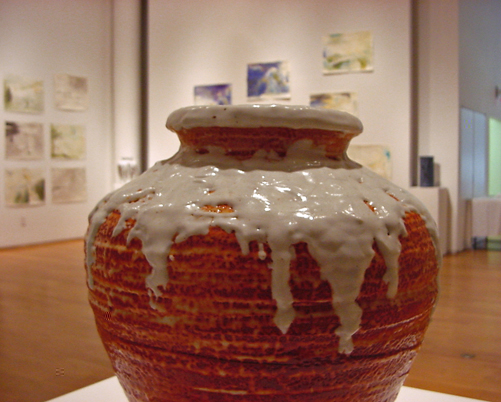
While Nakazawa creates delicate pottery that
is inspired by natural forms and in its delicacy is akin to the
Setowares of Murata Shiko, Mizuno’s work because of its accidental
effects relates more to the experimental Rakuwares of Honami Koetsu who
collaborated with Sotatsu for some of his ink paintings. The finesse
and smoothness of Nakazawa’s slips is contrasted with the bumpy
unevenness of Mizuno’s surfaces. Nakazawa’s effects are related to Ko
Setowares that exhibit a refinement in shape, elegant decoration and a
perfecting of technique akin to Chinese Song Dynasty ceramic
aesthetics. While Nakazawa’s colors are pale shades of green gray and
her textures smooth and shiny, her shapes relate to the water lily a
Buddhist symbol of rebirth. Mizuno’s thick splatter pattern glazes,
many in crackled white the forerunner of Shino-ware produced during the
Momoyama period, result from the carefully controlled manipulation of
the oxidation process at a low kiln temperature. The shapes of his
wares relate to tea ceremony pottery such as water jars, tea bowls,
storage jars, and to floral containers.
Like the Zen ink painters before him Okazaki’s
swift brushstrokes hold only the briefest relationship to reality and
for the most part his landscapes are abstract. However Okazaki’s
paintings although may hold some tentative relationship to the past in
their use of accompanying text are contemporary fragments that can be
read individually or collectively. Like Sesshu Toyo the greatest of
Japanese ink painters Okazaki engages in the painting of the seasons
changing our perception of the landscape from an unchanging universal
to the immediacy of the moment. Like Sesshu’s haboku the free and
broken ink landscapes of Okazaki both demonstrate the facility of his
brush as well as his embrace of the element of fortuitous accident and
suggestiveness. Few masters can convey with ink and incredible economy
the landscape’s essence while maintaining its spirit.
According to Chinese legend one member of the
three friends the prunus is associated with early spring and new life
as well as the five clans of China. Another, the bamboo is respected
for its durability and fortitude. Finally, the pine because it is an
evergreen is known as an emblem of longevity and is metaphorically
considered the friend who remains constant even through adversity. Like
these historically important plants and their motifs, the three arts of
haiku, sumi-e and ceramics as represented by the paintings and poetry
of Okazaki, and the ceramics of Mizuno and Nakazawa relate to Japanese
continuity but also its diversity.
|
|
| 22 (Fri.)
- CONCERT: American Composers Alliance (new music)
|
|
8:00 PM
Festival of American Music 2007
MUSIC FOR PIANO DUO
Showcasing the works of 35
composers performed by more than 60 musicians from across the country.
Featuring music of the 21st century with 30 World, U.S. and New York
Premieres. Including a brand new opera, a chamber concerto, electronic
music, solo works, piano duos and so much more.
The American Composers Alliance’s concert series was begun in
2000 to make American contemporary music available to a broader
audience. Because our festival performs the work of young composers, as
well as those already well established, and offers lively, accessible,
and well-rehearsed performances, we draw audiences that include many
students from around New York City, as well as more traditional new
music audiences.
Three concerts were presented each year from 2000-2002. In 2003, the
series evolve into a festival of six concerts over one weekend, in
celebration of ACA’s 65 th Anniversary. ACA’s concerts offer
audiences the rare opportunity to hear and appreciate the music of fine
composers from around the country, who are rarely performed inNew York
City .The festival also offers younger, emerging composers an
opportunity to hear their music performed by fine professionals, giving
them a starting point for their careers. Finally ACA, with its long and
rich history, is committed to performing works by its founders and
important early members, giving both an important historical
perspective and links to the music of today.
The ACA festivals have begun to offer the entire music community a
central meeting place, where people can come to hear a great variety of
American classical music. ACA, true to its original mission, remains
committed to supporting American music and to exposing the music of our
members, past and present, to the broadest possible audience.
PROGRAM
Elizabeth Bell : Duovarios for Two Pianos †
Elliott Schwartz: Test Drive for piano duet †
John Cage: Experiences
Robert Helps: Eventually the Carousel Begins
Aaron Copland: Danzon Cuban
|
CLICK
HERE for more information on the AMERICAN COMPOSERS ALLIANCE
|
|
23 (Sat.)
- POETRY: Haiku Society Meeting (haiku)
|
|
2:30 PM
FREE
ADMISSION
The
Haiku Society of America is a not-for-profit organization founded in
1968 to promote the writing and appreciation of haiku in English.
Membership is open to all readers, writers, and students of haiku.
The
HSA has been meeting regularly since its inception and sponsors open
lectures, workshops, readings, and contests. As of December 30, 2005,
the HSA had a total of 832 members around the country and overseas.
The
Society's journal, Frogpond, which features work by the HSA members and
others, as well as articles and book reviews, is in its 29th year of
publication. The HSA also publishes a quarterly Newsletter containing
reports of the Society's national meetings and news of regional,
national, and international events.
The
HSA maintains a Web site with additional information about the Society,
archives of winners of the HSA contests, and other haiku activities at http://www.hsa-haiku.org.
During
2005, national meetings were held in Evanston, IL, Minneapolis, MN,
Port Townsend, WA, and New York, NY. Numerous regional meetings also
took place around the country.
|
CLICK
HERE for more information on the HAIKU SOCIETY
|
|
| 24 (Sun.) -
SALON SERIES: Sachiyo Ito & Co. (Okinawan Dance and Martial
Arts) |
|
3:00 PM
ADMISSION
$10, $7 Students/Seniors
Sachiyo
Ito & Co.
SALON SERIES NO. 29
Salon Series No. 29 will examine
closely the relationship between Okinawan Dance, particularly the male
dance, called Otoko Odori, and martial arts, with a focus on karate.
The discussions and demonstration will include: the basic stance,
posture, Kata (the movement patterns) that have influenced the
choreography in the dance, the breath work, and also the mental
attitude, necessary in the development of the arts. The special guest
will be Masahiko Honma, Chief Director of Karatedo Honma Dojo in New
York. Sachiyo Ito will perform Meh-nu-hama, and Takadera Manzai, from
Otoko Odori repertory of Okinawan Dance.
Salon Series offers a series of informative public programs and
educational lectures, lecture-demonstrations, and performances aimed at
those interested in deepening their knowledge of the performing arts of
Japan. They are held on Sunday afternoons, three times a year.
Refreshments are served during the Q/A period.
Salon Series No. 29 is supported, in part, by Fund for Creative
Communities, administered by the Lower Manhattan Cultural Council.
|
CLICK
HERE for more information on SACHIYO ITO & CO.
|
|
Tenri
Cultural Institute is located in Greenwich Village at 43A West 13th
Street between 5th and 6th Avenues
Our location is convenient to the PATH train and most subway lines:
F, V and L trains stop at 14th St. and 6th Ave.
1, 2, and 3 trains stop at 14th St. and 7th Ave.
N, R, Q, W, 4, 5, and 6 trains stop at 14th St.-Union Square station.
for more information, call (212) 645-2800 |

|


